jueves, 14 de marzo de 2013

INFO ABOUT OUR SCHOOL


VERMONT SCHOOL


My school is situated in the town of  "el retiro"  it a good and beautiful school it has a good level of education and I feel very happy of study here. The school is very big and it has exelent and beautiful theings also it has a lot of excellent frineds and teachers  my class is 7A I am in secundary it is hard but I lern a lot also the class of science is interesting and I know a lot of new things.

Alejandro Castaño Osorno.

miércoles, 6 de marzo de 2013

Chemistry

MATTER AND ITS PROPERTIES


Matter structure and properties
Matter: All surrounding us that have mass and takes up space. Light and sound are not matter. All matter is made up of millions of atoms.

Matter states
1.1 Bose-Einstein
It was created by scientists in a lab and it can´t be found in nature. Its particles are packed closer together than a solid´s particle and they vibrate less.
1.2 Solids
Have a definite shape and takes up certain amount of space. Particles are packed close together vibrating in place. That is why solids are rigid.
1.3 Liquids
Have their own volume but it takes the shape of its container. They can be poured from one container to another. The particles are farther apart. They are able to move a little, so liquids change shape and flow.
1.4 Gases
Have not a definite shape or volume. It takes up all the space of its container. The particles are far apart. They move rapidly, always getting farther apart until something stops them.
 

1.5 Plasma
It is produced when electrons get out of the orbits when the temperature is so hot. Particles of plasma are far apart and moving faster than gas´ particles. They produce light.
2.      Properties of matter
There are two main properties that all objects have…
2.1 MASS: Is the amount of matter is there in an object. Mass doesn´t change if the shape of the object changes. Is measured in grams.
2.2 VOLUME: Is the amount of space an object takes up. Is measured in milliliters or cm3.
3.     Physical properties
Physical properties can be observed or measured without changing the composition of matter. Physical properties are used to observe and describe matter…
Some examples are: Odor, appearance, texture, color, shape, size, solubility, melting point, boiling point, etc.

3.1 DENSITY: Is physical property of matter and it measures how closely object´s atoms are.  Is the relationship between mass and volume.
Density= mass/volume (grams/milliliters)
Mass= density × volume
Volume= mass/density

3.2 MELTING AND BOILING POINT: Are physical properties of matter that describes the temperature at which solid, gas or liquid will change state. Melting point is always lower than boiling point. The pressure affects these physical properties.
Example: Water: 100oC boiling. 0oC melting.

3.3 TEMPERATURE SCALES
  • Fahrenheit: oF- 32 x 5/9= oC
  • Celsius: oC x 9/5 + 32= oF
  • Kelvin scale: Temperature scale beginning at absolute zero (-273.15°C or -459.67°F). there is no more before absolute zero.
4.      Physical changes
A change in state is a physical change, a change in which the substance itself is still the same substance. Its form changes, but its chemical makeup or composition doesn’t. Matter is not lost in these changes…
4.1 Freeze: when a liquid turns into a solid by the cold temperature.
4.2 Melt: when a solid turns into a liquid by the hot temperature.
4.3 Boil and evaporate: when a liquid turns into a gas by the hot temperature.
4.4 Condense: when a gas turns into a liquid by meeting with something 

5.      Chemical properties
Chemical properties describe an object´s ability to change into another substance or change its chemical composition…
5.1 COMBUSTIBILITY: Measures how easily a substance will burn or combine rapidly with oxygen.
5.2 REACTIVITY: Is the ability of a substance to go through a chemical change or reaction.

6. Chemical changes
When one substance changes and results into other substance or substances is called chemical change. When the chemical composition of an object changes, when the color change indicates there is a change. Chemical changes doesn´t create new matter, just new substances…
6.1 Burning: when an object is subjected to fire, it changes its chemical composition, for example, wood when burns it changes to ash.
6.2 Corrosion: when iron combines with oxygen in the air, rust forms. The rust is a brand new substance. It’s a combination of iron and oxygen with properties different from either of them.
More examples of chemical changes are: Mixing chemicals, cooking some types of food, mixing some ingredients, digesting food, explosions, in the photosynthesis, etc.


Follow the next link for an activity: http://my.hrw.com/sh2/sh07_10/student/flash/virtual_investigations/hst/mat/hst_mat_vi.html

Follow the next link for the solution of the activity:
file:///F:/MATERIAS/SEPTIMO/BIOLOGIA/VIRTUAL%20LAB%20REPORT%20II.htm

jueves, 31 de enero de 2013

TAXONOMY


1.    Write the procedure to classify an animal or a green plant.

There are several methods of classify organisms: Autotroph and Heterotrophs, Multicellular and Unicellular, Dichotomous Keys, Cladograms, Binomial Nomenclature. To use the Binomial Nomenclature, developed by Carl Linnaeus, you use: Domain, Kingdom, Phylum, Class, Order, Family, Genus, Species.

2.    What is the function of taxonomy?

Categorize organisms by descriptions, features and names in a hierarchical order, permitting differentiate and group organisms one from another, setting and identifying a natural relationship between them. 

3.    Who developed the taxonomy strategies to classify the living things?

First developed by Shen Nung in China, passing to the Greeks like Aristotle, Plato, Plinius, Theophrastus, etc., until get to the 14 and 15 centuries with Carolus Linnaeus and the Binary system, and the one that we use now, modified by other modern scientists and getting a combination of all theories and methods gave since the beginning to the end.

4.    Set the five kingdoms of the nature.

The 3 domains are: Eukarya (cell with nucleus), Archae (bacterias from the prehistory that resist extreme conditions) and Eubacteria (common bacterias)

The 5 kingdoms are: Bacteria (unicellular prokaryote), Protista (unicellular eukaryotes), Animalia (multicellular heterotrophs), Plantae (multicellular green autotrophs) and Fungi (multi and unicellular heterotrophs decomposers)


Follow the link to do an activity about taxonomy: http://www.glencoe.com/sites/common_assets/science/virtual_labs/E07/E07.html

jueves, 24 de enero de 2013

Muscles, bones and joints
 here you are going to obtain information about all the main joins muscles and bones of the human body.  Also you are going to see the ubication and the function of each of these.
you also are going to had activities to measure your knowledge.

Living things
Here you are going to obtain infotmation about taxonomy his function and proces you also are going to obtain information about the history of taxonomyand the proces to classify animals and plants.

Plants
here you are going to obtain information about the classes of plants the main parts of the plants their function and all you need to know about it.


lunes, 3 de diciembre de 2012

MUSCLES, BONES AND JOINTS

Follow the video to see information about bones, antagonist muscles and types of joint...

 
Copy and Paste the link to see and follow a Webquest: 

jueves, 22 de noviembre de 2012

SKELETAL SYSTEM

THE HUMAN SKELETON

Follow the links to get information about the human skeleton and skeletal system of different animals: http://www.enchantedlearning.com/subjects/anatomy/skeleton/Skelprintout.shtml; E:\MATERIAS\SEPTIMO\BIOLOGIA\SKELETON COMPARISSON.htm

...After knowing the basic concepts of the skeleton, gather skeleton vocabulary, like bones, functions, parts, etc, and unscrable the next words:
1. snoeb
 
2. caalrps
 
3. lceriatag
 
4. obeehneck
 
5. cvleclai
 
6. ilfaac

7. fmeur
 
8. iualfb
 
9. odhaeref
 
10. iph

11. wbjonae
 
12. esnlatgim
 
13. rwramo
 
14. ermtaalcpa
 
15. raametaslt

16. alnsa
 
17. latlpea
 
18. sgehplaan
 
19. rtpteco
 
20. dirasu
 
21. srib
 
22. tonkesle
 
23. lsklu
 
24. esutnmr
 
25. utropsp
 
26. rastasl
 
27. iaitb
 
28. alun
 
29. breveraet


domingo, 18 de noviembre de 2012

LIVING THINGS IN THEIR ENVIRONMENT

THIS IS A SHORT INTRODUCTION FOR THIS INTERESTING TOPIC, LIVING THINGS INTERACTION, AT THE END THERE IS A POWER POINT PRESENTATION WHERE MORE INFORMATION IS GIVEN...

FOOD CHAINS
Food chains show how organisms get food, nutrients and energy, passing from one to another and another…
Shows what eats what or what is eaten by what in a biological community, that is called ENVIRONMENT.

FOOD WEBS
Food webs are 2 or more food chains that are linked or overlapped.
Humans are part of a food web.
In the different ecosystems or biomes, there are more than one food webs.
Food webs change by an increase or decrease of plants or animals.

SEE ALL ABOUT FOOD WEBS AND FOOD WEBS:

XYLEM, PHLOEM AND STOMATA OBSERVATION


Studying Vascular Tissues of a Plant, which act as an Aqueduct for it:                 Observing Xylem and Phloem

EXPERIMENT 1: CELERY JARS.

OBJECTIVES

·         Identify and recognize the Xylem and Phloem in the plant.

·         Know how plants transport water and nutrients from the bottom of the plant (roots) to the leaves and its effect.

·         Plan and design easy ways to identify the channels of the stem.

MATERIALS

·         Food colorant (2 different colors)

·         Two cups

·         Scissors or a knife

·         Marker          

·         Gloves

·         Lab coat.

·         Microscope (OPTIONAL)

·         Slides (OPTIONAL)

REACTIVES

·         Water (H2O)

·         2 stalks of celery with leaves

PROCEDURE

1.    Set a cup or a container with water.

2.    Pour the food colorant to the water and stir it to color the water.

3.    Get two stalks of celery, with leaves.

4.    Place the stalks of celery in the cup, 1 stalk per each.

5.    Measure and indicate the level of water with the marker.

6.    Let the celery there around 1 to 2 days.

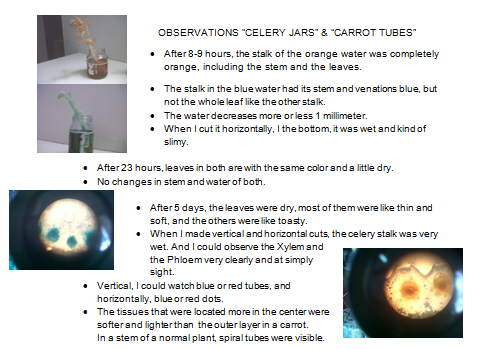
7.    Observe and record changes of the leaves, the amount of water, and the veins.

8.    After the 1 or 2 days, take out the stalks and cut it horizontally several times in different points, to observe the dots with the color of the water. Those are the channels of the plant.

9.    Draw and record the color of the veins and leaves and observe other changes.

10. Cut it vertically to see more vessels clearly.

11.  (OPTIONAL) You can observe it in the microscope for more observations, with the objectives 4X, 10X and 40X. If you do this, cut a very thin slice.

Observing Tiny “Noses” located in the Leaves: Knowing Stomata

EXPERIMENT 2: STOMATA IMPRESSIONS

OBJECTIVES

·         Identify stomata in the leaves and know its function

·         Understand how leaves take in gases.

·         Know an easy way to observe stomata.

MATERIALS

·         Clear fingernail polish

·         Transparent tape

·         Microscope

·         Slides

REACTIVES

·         3 leaves of different plants

PROCEDURE

1.    Take 1 leaf from three different plants.

2.    Paint a thick layer of polish in the back part of the leaf, preferable at the bottom.

3.    Let the polish to dry (around 20-25 minutes)

4.    When dry, tape the patch.

5.    Peel slowly the tape and see that the polish is attached.

6.    Paste the tape with the print to a slide.

7.    Turn on the microscope and set the slide so that you can observe stomata.

8.    Observe and draw and record the observations.

9.    Repeat steps from 2 to 8 with the other two leaves.

10. Compare and deduct in which leaf were more stomata and why.